Valley Heat, City Water 2 of 4
Two Different Waters, One Service Map: Why Ice Makers Scale Faster in Tarzana Than in Windsor Square
Written by
Elena Sandoval
Refrigeration technician — cabinet, door and seal work · 24 years in the trade
Checks seal geometry and door closure first on a warm-cabinet call. A unit fighting a poor seal all day makes the sealed system read badly, and the readings only mean anything once the door is closing the way it was built to.
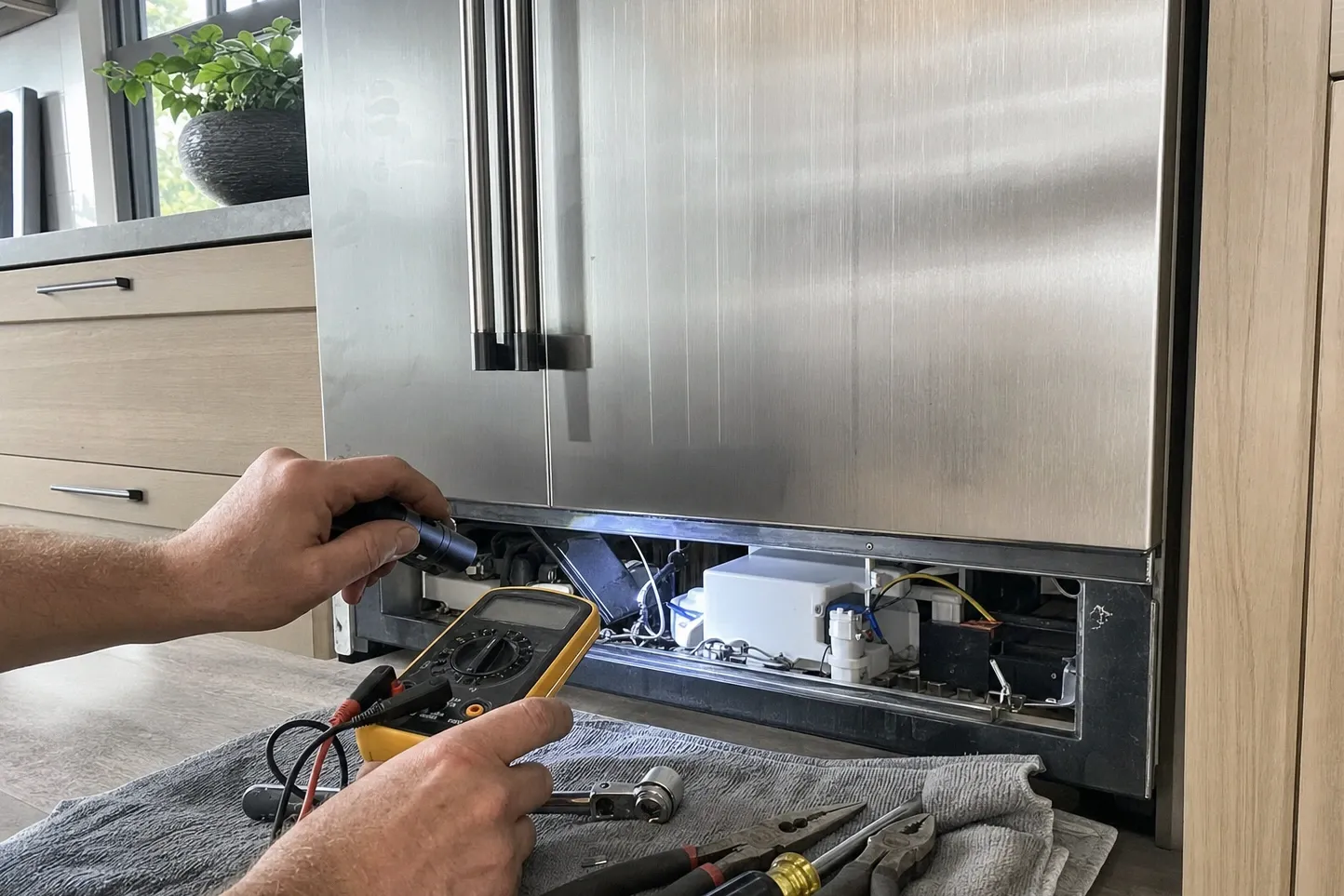
LADWP publishes water hardness by source rather than by address, and in calendar year 2024 those sources were not the same water. The LA Aqueduct Filtration Plant averaged 112 mg/L of total hardness as calcium carbonate across a tight 109 to 113 range. The Northern Combined Wells averaged 122 mg/L but ranged as high as 174. The Southern Combined Wells averaged 142 and ranged to 195. MWD’s Jensen plant came in at 148.
Where those sources go is set by LADWP’s own internal service areas, and this company’s map straddles two of them. Toluca Lake and Tarzana are listed as San Fernando Valley communities, fed by the aqueduct plus the Northern Combined Wells plus Jensen. Windsor Square and Beverly Grove fall inside the Central Los Angeles area, fed by the aqueduct plus the Southern Combined Wells.
Be honest about what that means. Nobody tastes the difference between 112 and 142 mg/L, and no one is going to look at a glass and identify their service area. Converted, 112 mg/L is about 6.5 grains per gallon and 195 mg/L is about 11.4 — real, but not dramatic. What actually reaches your ice maker is not the gap between two neighbourhoods; it is the fact that a Valley address is a blend, and blends move through the year as the utility shifts between aqueduct water, local groundwater and Jensen.
The call we take most often here
Cloudy, hollow, fused or undersized cubes with the ejector sticking part way through harvest. It is the single most common ice complaint we take, and in the large majority of cases the module is mechanically sound. What has changed is the mineral load that module has been fed since the last filter change.
That distinction is worth money, because a module and a descale are not the same invoice.
Why this address produces it
Because the water arriving at a Tarzana kitchen is assembled from three sources and the mix is not fixed. Aqueduct supply is stable — the 2024 range for the filtration plant was only four units wide. Groundwater is not: the Northern Combined Wells ran from 106 to 174 mg/L over the year. Lean harder on wells and Jensen during a hot stretch and the water in the fill tube genuinely changes.
Toluca Lake is on the same Valley blend. Windsor Square and Beverly Grove draw a different one — aqueduct plus the Southern Combined Wells, which averaged higher at 142 mg/L but came from a different rotation.
The practical result is that a filter interval printed on a carton, or a habit picked up at a previous address, is a guess. Two customers of one utility, ten miles apart, are not descaling on the same schedule, and neither of them is on a schedule that holds steady across a whole year.
The chain, from cause to complaint
Minerals leave the water wherever the water changes state or slows down. In a built-in ice maker that means four places, and each of them produces a complaint you can read backwards to its cause.
Scale in the fill tube narrows it, so the fill dribbles instead of pouring and the mould does not receive its full charge. That is your hollow, undersized, collapsing cube. Scale in the mould itself gives the ice something to grip, so cubes stay put when the ejector sweeps, and the motor stalls with that grinding noise every couple of hours. Scale on the inlet-valve screen drifts the fill volume slowly, which is why the ice gets worse over months rather than overnight. And scale in the drain path holds water where it should not sit, so it freezes into a ridge under the module.
Meanwhile the filter is doing its job at a rate the calendar knows nothing about. A cartridge on a harder blend exhausts sooner, and once it is spent, everything above happens faster.
Ruling out the obvious first
Before anyone opens the module, four things are worth checking yourself, in this order.
Filter age, measured in water rather than in months — a household of six on a hot August is not the same as a couple in February. Cube shape next, because hollow and undersized point at fill volume while fused and clinging point at the mould. Then run a descale using a product intended for potable ice equipment, and give it the full dwell time rather than a rinse. Then look at the supply itself: a stop valve barely open, or a saddle fitting slowly closing itself, mimics scale perfectly.
If a fresh filter and a proper descale restore cube shape within a few cycles, you have both diagnosed and fixed the fault, and you have also learned your real interval. Halve the time to the next check and see what the ice tells you.
When it stops being a homeowner job
When cube quality does not recover after a filter and a descale, the fault has moved into hardware: the inlet valve, the ejector or thermistor in the module, or the supply line between them. That work is quoted after the diagnosis, against the published band for ice maker, water valve and supply-line repairs.
The one thing worth resisting is a control board on the strength of an ice complaint alone. A board sits in a higher band than the water work, and an ice maker that is being starved of water or gripped by scale will produce exactly the erratic behaviour that gets blamed on electronics. The board is the last conclusion, not the first.
A visit is a flat $89, which buys the drive out and a full diagnosis — water pressure and fill volume measured, the module examined, and a straight answer about your interval rather than a printed one. Sub-Zero Repair Service Los Angeles works Toluca Lake, Tarzana, Windsor Square and Beverly Grove, on (310) 499-2240.
Follow-ups
- How often should I change the ice-maker filter in Tarzana?
- More often than the carton suggests, and on evidence rather than a date. Valley supply is a blend of aqueduct water, local wells and Jensen, and the well component ranged from 106 to 174 mg/L across 2024, so the load on a cartridge is not constant. Start from a clean baseline, watch cube shape, and when it softens, that gap is your real interval.
- Would a water softener stop cloudy ice?
- It would cut the mineral load reaching the module, which is the underlying cause, but it is a whole-house plumbing decision rather than an appliance fix and it changes everything else in the house too. For most kitchens on this map a correctly timed cartridge change plus a proper descale of the fill tube and mould solves the cube problem with far less disruption.
- My ice was fine for years and got worse this summer. Did something change?
- Quite possibly the water did. LADWP shifts between sources through the year, so a Toluca Lake or Tarzana kitchen can sit on aqueduct-heavy supply in one season and a harder groundwater blend in the next. Nothing inside the appliance has to fail for cube quality to fall away. Change the cartridge, descale properly, and see whether the ice recovers before assuming a part has gone.