Valley Heat, City Water 4 of 4
Sub-Zero Wine Cooler Problems, in the Order They Show Up
Written by
Elena Sandoval
Refrigeration technician — cabinet, door and seal work · 24 years in the trade
Checks seal geometry and door closure first on a warm-cabinet call. A unit fighting a poor seal all day makes the sealed system read badly, and the readings only mean anything once the door is closing the way it was built to.
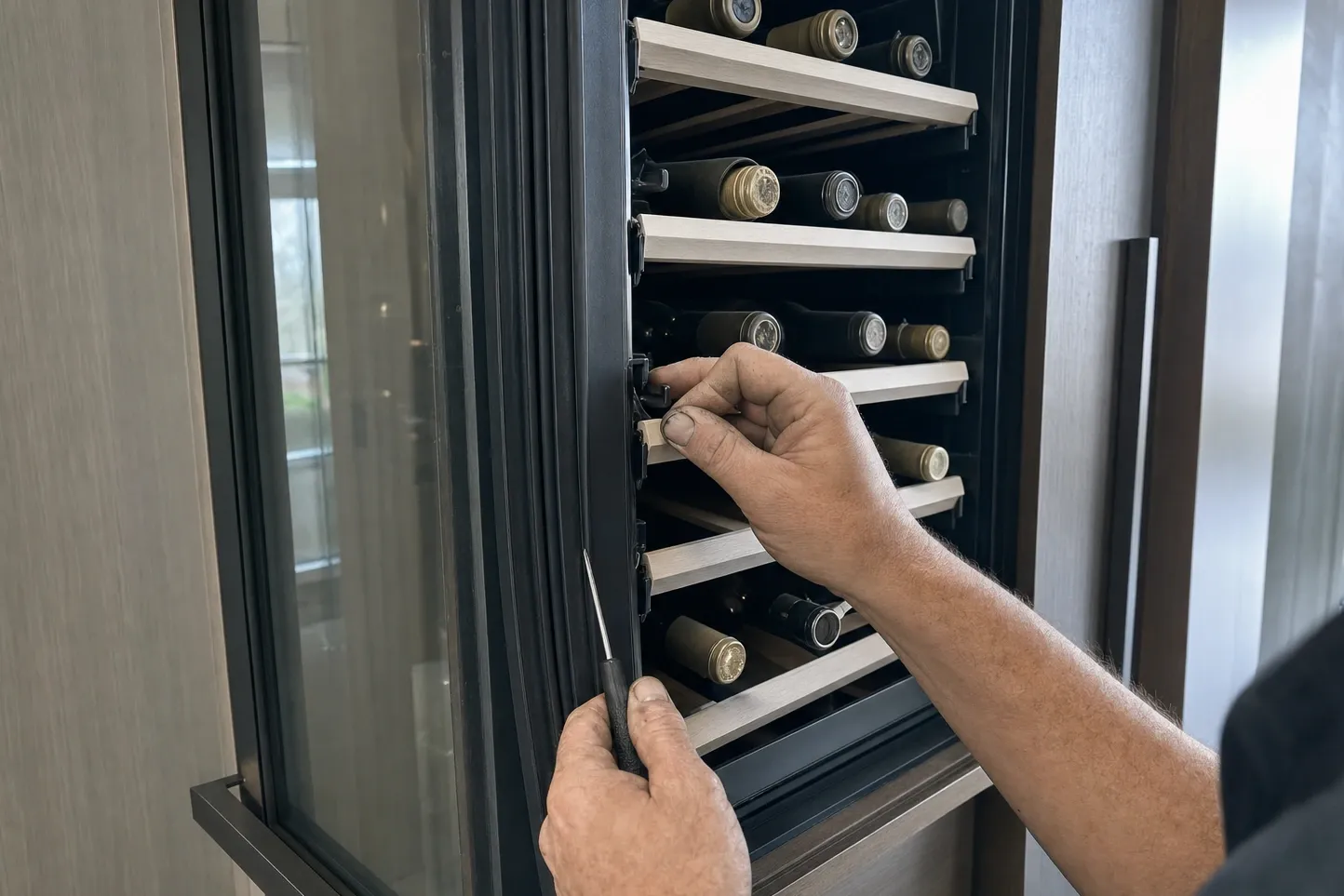
Most Sub-Zero wine cooler problems come down to four things, and they tend to arrive in this order: a condenser clogged with dust that lets the bottles creep warm, a glass-door gasket that has stopped gripping, a new noise from a fan or from the unit touching its cabinetry, and water that collects because a drain is blocked. The first two an owner can check in an afternoon with a soft brush and a strip of paper. Controls and the sealed refrigeration system come last, and that is where a homeowner should put the tools down. In a Los Angeles kitchen where the wine column sits flush in custom millwork, working in this order also saves you from pulling a unit out of its opening to chase the wrong fault and marking panels cut to match the room.
Check the setpoint and the display first
Before assuming anything has failed, look at what each zone is actually set to. On Sub-Zero’s Designer (IW), Classic (BW) and UW-24 wine storage, the dial reaches from 39°F at the cold end up to 65°F, and a red or a white is equally at home in either zone. A zone reading 45°F may simply have been set there by whoever in the house likes a colder white. Designer Undercounter (DEU) wine units run from 40°F to 65°F, and the 24-inch DEU2450W has two wine zones that are adjusted independently.
A brand-new unit needs patience. Sub-Zero notes that a freshly installed wine unit may pull only one zone down to temperature at a time, so a second zone that lags on the first day is normal behavior rather than a defect. Add bottles in batches instead of loading every rack at once with cases that have been sitting in a warm car.
Warm bottles: clean the condenser, then wait a day
When the wine feels warmer than the display promises, the condenser is the first suspect. It is the finned coil that throws off the heat the unit pulls out of the cabinet, and on built-in wine storage it sits behind a grille at the top or the bottom depending on the model. Dust and pet hair packed into those fins make the compressor run longer to move the same amount of heat.
Sub-Zero’s advice for a warm wine unit is plain: if the condenser has not been cleaned in the last three months, clean it, then leave the unit alone for 24 hours before deciding whether it recovered. As routine upkeep the company suggests every six to twelve months, and more often in a home with dogs or cats. Switch the unit off first. A soft brush and the vacuum’s crevice tool do the job, as long as every stroke follows the direction of the fins so the thin aluminum never bends. Spray-on chemical coil cleaners are unnecessary, and Sub-Zero advises against them.
Heat makes all of this worse. On a summer afternoon in Tarzana or Toluca Lake, the air feeding that coil is much hotter than it is near the coast, and a condenser that coped in spring can fall behind by August. Our page on condenser heat load during hot Valley summers explains why.
The glass door and the seal around it
If the coil is clean and a zone still drifts warm, turn to the door. A wine unit gets opened often just for browsing, and the gasket on a glass door absorbs that wear quietly until it stops sealing. Close the door on a strip of paper at several points along each edge; where it slides out with no drag at all, that stretch is leaking. A door that does not close fully often sets off the door alarm before the wine warms, so if a chime is what sent you here, start with why the door alarm keeps beeping. Moisture on the glass and a zone wandering off its setting are covered in our guide to wine column zone drift and sweating glass.
Clean a gasket before you condemn it. With the unit off, wipe it with a soft cloth and mild detergent in water. A baking soda paste lifts stubborn marks, and one part bleach to ten parts water deals with mold or mildew in the folds. Keep vinegar and rubbing alcohol away from it, since Sub-Zero says not to use either.
A gasket that is ripped, torn or cracked has to be replaced, and Sub-Zero recommends that a service technician fit it. The gaskets are not sold online at all; they come only through the brand’s parts distributors. Door gasket or seal replacement typically runs $270–$690, and the exact price is set once the door has been looked at.
Noises, from normal to worth a call
A wine unit is never silent. Expect a low hum while the compressor runs, a soft rush of air from the fans that keep temperature even from top rack to bottom, and the occasional tick as parts warm and cool. None of that is a fault. These sounds deserve attention:
- A rattle or buzz that comes and goes with the compressor. Usually a bottle touching the back wall, a rack that has shifted, or the side of the unit resting against a cabinet panel. Move the bottles and listen again.
- A grinding, chirping or whine that never lets up while the unit runs. That is typical of a fan motor with tired bearings, either the evaporator fan inside the cabinet or the condenser fan beside the coil. Replacing an evaporator or condenser fan motor usually costs $300–$740.
- A loud clunk, or a compressor that clicks on, quits and tries again within minutes. Stop there. That points toward the starting components or the sealed system and is a job for a technician.
Never reach behind a fan grille or into the machine compartment while the unit has power.
Water inside the cabinet or on the floor
Wine storage pulls moisture out of the air as it cools, and that water normally runs down a drain to a pan near the compressor, where warmth from the machine evaporates it. When the drain clogs, the water backs up and pools under the lowest rack, or the pan overflows onto the kitchen floor. Check the cabinet floor for standing water or a slimy film around the drain opening. Sub-Zero wine storage, apart from the IW-30CI, has no internal water filter, so a leak from one of these units is almost never a filter housing. If you can reach the opening, warm water and a soft pipe cleaner may clear a light blockage; anything deeper on a built-in unit sits behind panels best left alone.
Cleaning a Sub-Zero wine cooler properly
Once or twice a year, a thorough clean keeps most of the problems above from starting:
- Move the bottles of one zone at a time to a cool, dark spot so they are out of the unit for as short a time as possible.
- Switch the unit off and wipe the racks and interior walls with a mild soap solution, then dry everything with a soft cloth.
- Clean the glass with a soft cloth and nothing abrasive, inside and out.
- Wash the gasket the way described above and dry it fully before closing the door.
- Brush the condenser if it is due, then restore power and let the zone settle before reloading.
When to stop, and what repairs typically cost
Call once a zone is still warm a day after a condenser clean, when the compressor keeps short cycling, when the display shows a fault you cannot clear, or at any burning smell. The visit is a flat $89 that covers the trip and finding the fault, and that amount comes off the bill as soon as you approve the repair. Typical ranges, with a firm figure only after diagnosis:
| Repair | Typical range |
|---|---|
| Door gasket or seal replacement | $270–$690 |
| Evaporator or condenser fan motor | $300–$740 |
| Defrost heater, thermostat or sensor | $270–$640 |
| Electronic control board | $440–$890 |
| Compressor or sealed-system repair | $1,320–$3,410 |
Even the costliest sealed-system repair usually comes in far below the price of a comparable new built-in unit. To book a visit, call (310) 499-2240 or read more about our wine cabinet and glass door repair.
Follow-ups
- What is that new sound coming from my Sub-Zero wine cooler?
- A new rattle is usually a bottle, a loose rack or the cabinet side touching a panel, while a steady whine or chirp that runs whenever the unit runs tends to be a fan motor wearing out. A gentle hum and the sound of moving air are normal. Repeated clicking as the compressor tries to start is the one to stop on and have looked at.
- Why is my Sub-Zero wine fridge not cooling?
- The most common cause is a condenser coated in dust, so clean it if that has not happened in three months and give the unit a full day to settle. If it is still warm after that, check the door seal with a strip of paper. Warmth that survives both checks points to a fan, a sensor or the sealed system.
- Why is my Sub-Zero wine cooler leaking water?
- Water pooling under the bottom rack or on the floor usually means the condensate drain is blocked and the moisture the unit removes from the air has nowhere to go. Water beading on the outside of the glass is condensation instead, often helped by a weak gasket. A wine unit has no filter housing to leak, so those two causes cover most cases.
- Can I keep red and white wine in either zone?
- Yes, either zone of a Sub-Zero wine unit can hold red or white, because both zones cover the same span of temperatures. Set each zone for the bottles you actually keep in it rather than by a label, and leave a zone a day to reach a new setting before you judge it.