Overlay, Flush Inset or Stainless: Which Sub-Zero Do I Have?
Written by
Elena Sandoval
Refrigeration technician — cabinet, door and seal work · 24 years in the trade
Checks seal geometry and door closure first on a warm-cabinet call. A unit fighting a poor seal all day makes the sealed system read badly, and the readings only mean anything once the door is closing the way it was built to.
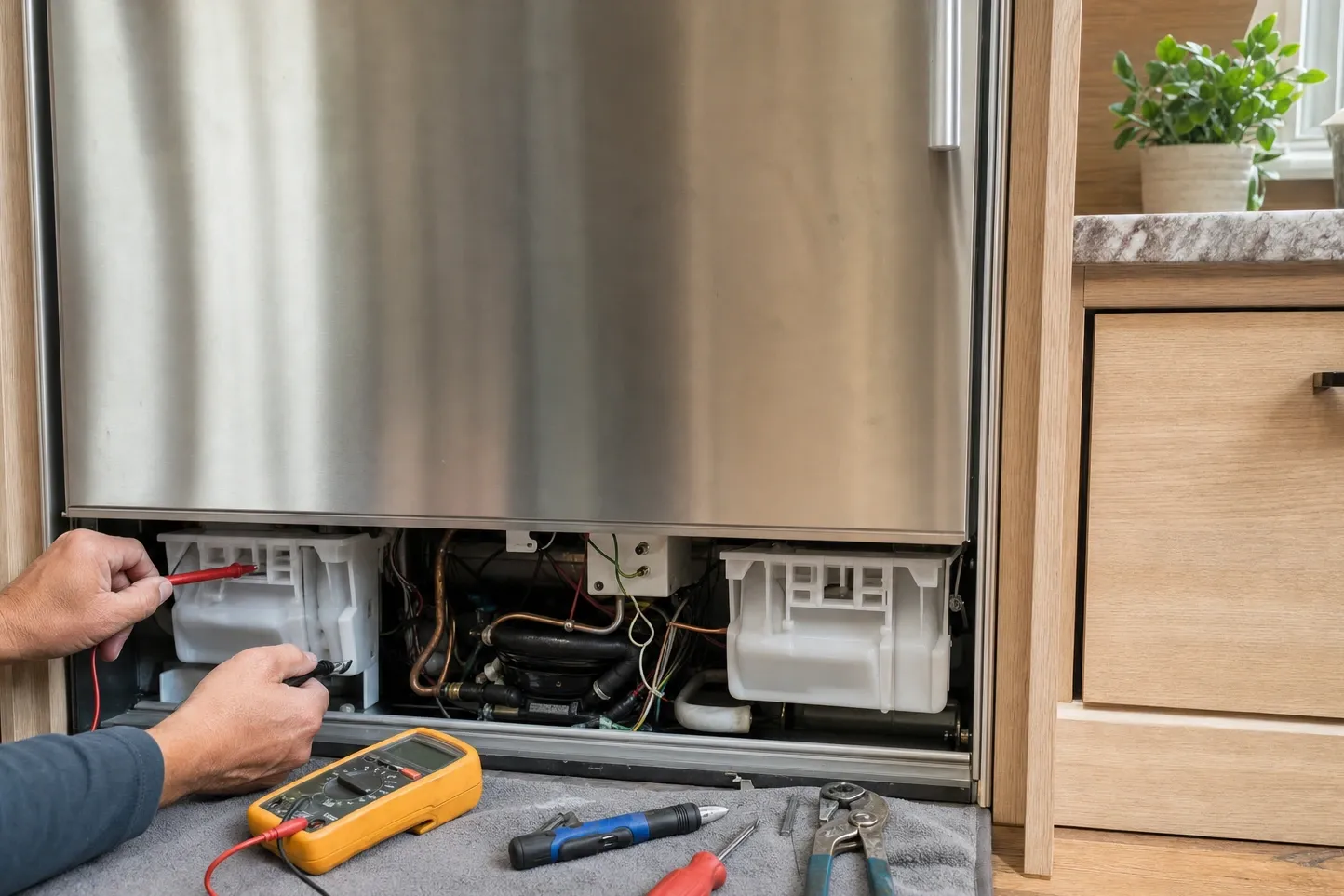
It sounds like a question about taste and it is really a question about geometry. How your refrigeration meets the cabinets on either side decides how much clearance a door has, how a fault announces itself, and what is involved in putting it right. It is worth being able to name yours.
Why this is the first question rather than a detail
Every complaint in this series — a door that will not settle, a mark on a cabinet edge, a reveal that has opened along the top — is a complaint about a few millimetres. How many millimetres you had to begin with depends entirely on how the appliance was fitted into the run. A cabinet with room around it tolerates a certain amount of movement and never mentions it. A cabinet fitted level with the joinery has no such margin, so the same movement is visible and audible within a week.
Stainless: the factory front, and the grille above it
The straightforward one. Sub-Zero offers Classic Series refrigeration in stainless steel or panel-ready, and a stainless cabinet leaves the factory with its face already on: metal doors, metal handles, and a stainless grille across the top, which the manufacturer describes as an emblem of the range going back decades.
If you can see that band of metal above the doors, you have a factory front and you are not in panel country at all. Nothing on the outside of your appliance was made by a joiner, and no question about panel weight or panel fixings applies to you.
Panel-ready, standing proud of the run
Here the appliance ships with a blank front and your cabinetmaker supplies the face, which is then hung so it sits on top of the run rather than inside it. Cabinetmakers call that overlay.
You can spot it from the side: the appliance front stands forward of the cabinet frames beside it by roughly the thickness of a door, exactly as the neighbouring cupboard doors do. Gaps between fronts are generous and even, and there is usually a little relief at the hinge edge. It is the most forgiving of the three, because there is space on every side for things to move slightly without touching.
Panel-ready, set level into the run
The same panel-ready cabinet, fitted so the face finishes flush with the joinery around it and the whole run reads as one continuous plane. Cabinetmakers call that flush inset. Sub-Zero’s Designer Series is built for this: the doors are panel-ready so they integrate with surrounding cabinetry, and the hinges are hidden, which is what produces the seamless look in a single installation or in two cabinets standing side by side.
Two things give it away. The first is that you cannot see a hinge from the front, at any angle. The second is that the reveal — the line of shadow around the front — is narrow, consistent, and clearly deliberate. A cabinet whose entire face is joinery shows no stainless grille either; the ventilation is behind a panel that matches everything else. Around Beverly Grove and West Hollywood, where kitchens tend to be designed as one continuous piece of cabinetry, this is the usual arrangement.
The ten-second test
Stand at one end of the run, put your eye near the plane of the fronts, and sight along it.
Metal face with a stainless band above the doors: stainless. Everything in timber and the appliance front standing forward of the frames with the rest: overlay. Everything in timber, the fronts all in one plane and no hinge visible: flush inset. If you are still unsure, open the door and look at the edge of the front — a custom panel usually shows its construction there, and a factory door does not.
What each one means when something goes wrong
On a stainless cabinet a dropped door is a hinge and seal conversation and nothing more. On an overlay installation it is the same conversation with the added question of what the front weighs. On flush inset, the front is also the finished surface of your kitchen, so the priority becomes putting the door back into a line that the eye is already reading across four other cabinets.
Knowing which you have makes the first phone call much shorter. Tell Sub-Zero Repair Service Los Angeles on (310) 499-2240 which of the three describes your kitchen, and the $89 visit starts from the right assumption rather than working it out on your floor.
Follow-ups
- Are overlay and flush inset Sub-Zero terms?
- No, they belong to cabinetmaking. The manufacturer offers stainless steel or panel-ready; what happens next is a joinery decision about whether the front sits on the face of the run or inside it. That is why two houses with the same appliance can look nothing like each other.
- Why does the answer change anything about a repair?
- It changes how much room there is to work in and how a fault shows itself. A front standing proud of the run has clearance to spare; a front set level into the run has almost none, so a door that has moved by a whisker announces itself by touching its neighbour.
- Can a stainless cabinet be converted to take a custom panel later?
- Treat that as a purchasing question rather than a repair one, because it turns on what the specific model was built to accept and how the opening around it was made. Ask the retailer or the installer for the model specification before anyone commits to new joinery.